
Home / Blog / How to treat a bedroom studio acoustically without spending a fortune
How to treat a bedroom studio acoustically without spending a fortune
Corners before walls, 100mm mineral wool before foam, and about £80 for four panels you build yourself. UK prices and the free steps to do first.
Some links below are affiliate links. We may earn a commission if you sign up or buy through one, at no extra cost to you. See our privacy policy.
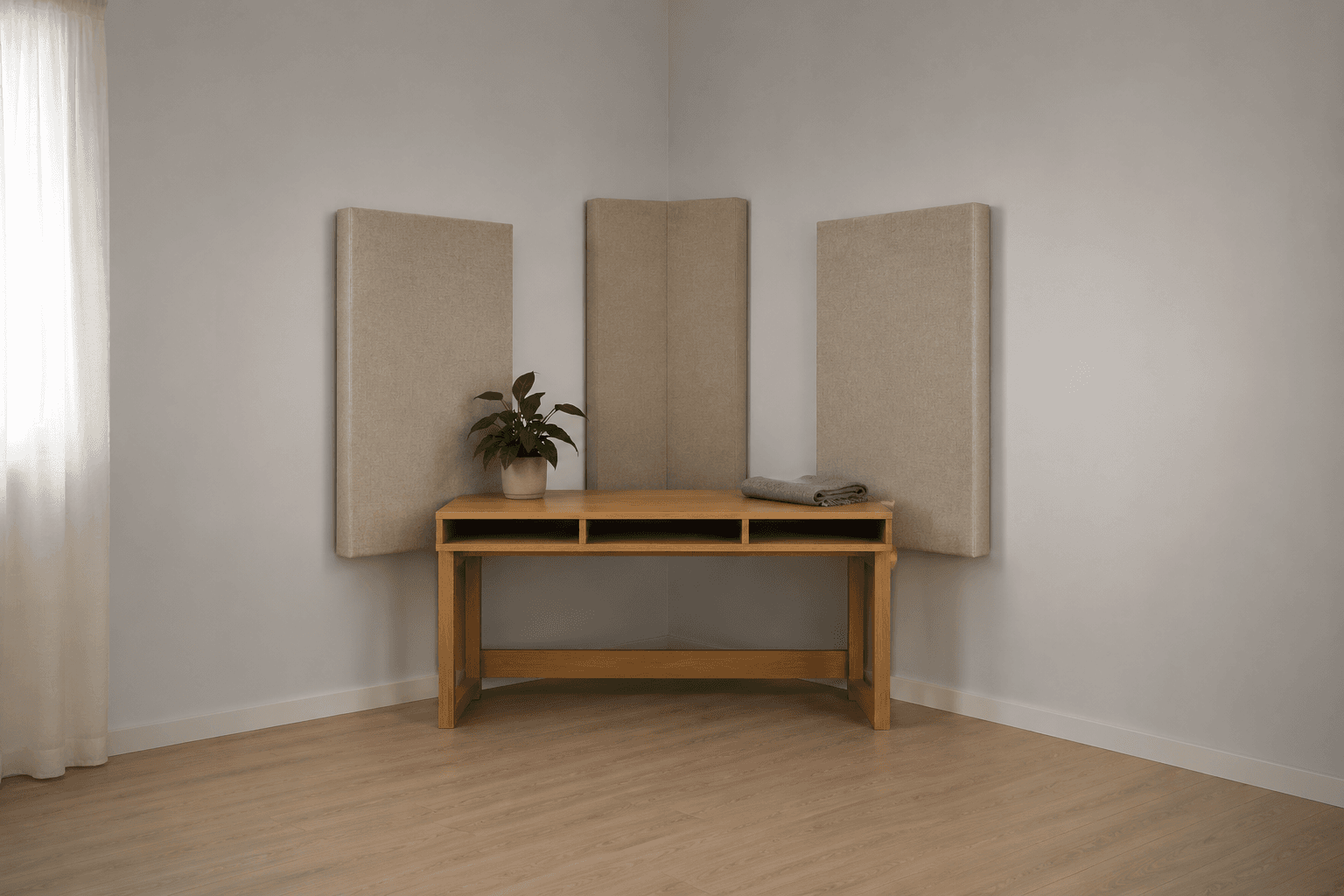
Treat the two front corners first, buy 100mm mineral wool instead of foam, and budget about £80 for four panels you build yourself. A 2.88 square metre pack of Rockwool RWA45 is £24.67 plus VAT at Trade Insulations, which works out cheaper per square metre than a set of foam tiles half the thickness. Before you spend anything, move the desk and get the room symmetrical either side of your head, because that part is free and it changes more than the first two panels will.
The reason a bedroom mix travels badly is that you are hearing your speakers plus the room, and the room is louder than you think. Sound leaves the monitor, hits a wall, and arrives at your ears a few milliseconds later, either adding to or cancelling what you heard first. Do that across a few hundred reflection paths and you get a frequency response with dips and peaks of 10dB or more that have nothing to do with your mix. You then EQ against them, and the corrections you made stop making sense in a car.
Quick verdict
Free first: desk off the centre of the wall, monitors at seated ear height, both sides of the room roughly matched. Under £30: one pack of 100mm Rockwool RWA45 or Knauf Rocksilk RS45, wrapped in an old cotton sheet and stacked across the two front corners. About £80: four fabric-wrapped 1200 x 600mm panels at 100mm thick, two at the side wall reflection points and two spanning the corners. About £150: eight panels plus a ceiling panel above the desk. Skip acoustic foam entirely until the corners are done.
Treatment and soundproofing are different jobs
Worth settling before you buy anything, because the wrong purchase here is the most common one. Acoustic treatment changes how the room sounds to you inside it. Soundproofing stops sound getting out to a neighbour or a sleeping housemate. Resonics, a UK acoustics firm, puts the distinction plainly: panels inside the studio improve the sound in the room and do close to nothing about transmission through the wall, because they have no useful mass.
Reducing transmission means mass, decoupling and damping: dense plasterboard, resilient bars, floating floors. In a rented bedroom that is off the table, and nothing on this page will help with it. What follows is entirely about what you hear at the desk.
The free part comes first
Three things cost nothing and beat your first £50 of panels. Get the monitors to seated ear height and make an equilateral triangle with your head. Move the desk off the exact centre of the wall and out of the corner. Then look at what sits either side of you: a wardrobe on the left and a bare window on the right will drag the stereo image sideways no matter what you hang on the walls later.
ADAM Audio's positioning guide adds the rule that catches most bedroom desks: sit the monitors either closer than 0.5m to the wall behind them or further than 1.5m away, never in between, because at those middle distances the rear reflection returns late enough to cancel part of the low midrange. Our studio monitor guide covers the geometry in more detail, along with the boundary compensation switches on the back of most monitors that exist for exactly this problem.
Why foam is the wrong first purchase
Thomann's best-selling acoustic tile is the EQ Acoustics Classic Wedge 30 at £48, and it has sold 1,229 units with a 4.6 out of 5 rating. It is 16 tiles of 300 x 300 x 50mm, so 1.44 square metres of 50mm foam, and the product description is honest about what it does: middle and high frequencies. Buy sixteen of those and stick them around your desk and you will get a drier, deader-sounding room with exactly the same bass problems it had before, plus a dull top end you have now removed on purpose.
The physics is unforgiving. Trevor Cox, Professor of Acoustic Engineering at the University of Salford, tested a range of porous absorbers for Sound On Sound and gives the working rule: a porous absorber needs to be at least a tenth of the wavelength thick to do much. At 500Hz the wavelength is 0.68m, so you need around 6.8cm. Down at 52Hz you would need roughly 65cm of material over a large area. Cox is blunt about the limit: porous absorbers are poor at treating the ringing of room-mode resonances, which is the thing making your low end unreliable.
The same argument applies to the foam corner traps. Thomann's number one bass trap is the t.akustik CBT-37 at £51 for two 370 x 370 x 600mm wedges, 4.5 out of 5 from 766 ratings. Its published density is 25 kg/m³. Matt Houghton, Sound On Sound's reviews editor, recommends 45 to 75 kg/m³ for broadband absorbers and around 100 kg/m³ for bass trapping. Mineral wool sold as building insulation lands in that range as standard, at a fraction of the price.
| DIY mineral wool panel | EQ Acoustics Classic Wedge 30 | t.akustik CBT-37 | |
|---|---|---|---|
| UK price | About £20 a panel to build | £48 the set | £51 the pair |
| What you get | One 1200 x 600mm panel | 16 tiles, 300 x 300mm | Two corner wedges, 600mm tall |
| Absorber thickness | 100mm | 50mm | 370mm of foam across the corner |
| Published density | 45 kg/m³ | Not published | 25 kg/m³ |
| Area covered | 0.72m² | 1.44m² | Two corners |
| Cost per m² of wall | £28 | £33 | n/a |
| Useful below 150Hz | Some, more with an air gap | Very little | A little |
Prices checked in August 2026. The framed DIY panel and the foam tiles land at similar money per square metre, which is the point worth taking from that table: for roughly the same spend you get twice the absorber thickness, and thickness is the only thing that buys you low frequencies. Skip the timber frame and simply wrap slabs in fabric and the DIY figure drops to under £14 per square metre.
Thickness buys bass, and an air gap buys more
The most useful free trick in Cox's testing is the air gap. Mounting a 25mm panel 25mm away from the wall absorbs about as much as a 51mm panel fixed flat against it. The reason is that most of the absorption happens in the part of the material furthest from the wall, where air particles are moving fastest. Right at a hard surface the air barely moves, so an absorber pressed flat against plaster is wasting its back half.
This is why picture-hook mounting works so well and why you should not glue panels to the wall. Hugh Robjohns and Paul White built ten portable traps for a Sound On Sound Studio SOS visit using 125mm deep frames with a 90mm air gap behind the wool, and reported that the gap made a real difference at low frequencies. They hung them on picture-hanging plates with keyhole slots so the panels lift down again, which matters if you rent.
Which wool to buy
Rockwool RWA45 and Knauf Rocksilk RS45 are both 45 kg/m³ rock mineral wool in 1200 x 600mm semi-rigid slabs, sold by builders' merchants rather than music shops. RWA45 at 100mm is £24.67 plus VAT for a 2.88m² pack of four at Trade Insulations, and the 50mm version is £28.98 plus VAT for 6.48m² if you want thinner panels or plan to double them up. Rocksilk RS45 at 100mm is £39.61 plus VAT for a five-slab 3.6m² pack. Prices vary by £10 or more between merchants for the same pack, so check two or three.
Corners first, then reflection points
Bass builds up where surfaces meet, so the corners are where an absorber sees the most low-frequency energy for its size. Start with the two vertical corners behind your monitors and fill them from the floor up to about 1.2m, which is roughly where your ears sit. A stack of 100mm slabs wedged across the corner at 45 degrees, leaving a triangular void behind, does more than the same wool spread flat across a wall. Robjohns and White's summary after ten traps and a ceiling panel was that you can never have too much bass trapping.
Only then move to the side walls. GIK Acoustics describes the mirror method for finding where the panels go: sit in your listening position and have someone slide a mirror along the side wall at speaker height. Anywhere you can see a monitor in the mirror is a reflection point. Mark both spots on each wall, one for each speaker, and that is where a panel goes. GIK also warns against over-precision, since reflections spread out and occupy zones rather than dots, so the area you cover matters more than hitting a mark exactly.
After the side walls, the two remaining spots worth a panel are the ceiling directly above and slightly in front of the desk, and the wall behind your head. Thomann sells a ready-made t.akustik PET Ceiling Absorber 120 for £77 if hanging a homemade panel overhead makes you nervous, and a foam ceiling panel stuck up with spray adhesive is a reasonable compromise there because the ceiling reflection is mostly a mid and high frequency problem.
What a DIY panel actually costs
One 1200 x 600mm panel at 100mm thick, built from UK materials at August 2026 prices:
- Mineral wool: £7.40, being one slab out of a £29.60 inc-VAT pack of four 100mm RWA45.
- Frame: about £5.80, roughly a length and a half of Wickes 38 x 63 x 2400mm CLS studwork at £3.85 each.
- Fabric: £2.50 to £3.75 of hessian, which Pound Fabrics sells at £2.50 a metre in a 100cm width. Any loose-weave cotton works; a bedsheet works.
- Screws, staples and two picture-hanging plates: about £3.
That is a shade under £20 a panel, so four panels for about £80 and eight for about £150 if you buy two packs of wool. Mineral wool cuts with a long bread knife and drops into a frame without glue. Cover it with something acoustically transparent, which Houghton stresses is there to trap stray fibres as much as anything, and wear a mask and long sleeves while you cut it.
Do not seal the front
The fabric over the front has to breathe. Anything airtight, so vinyl, plastic sheeting, a painted board or heavy waterproof canvas, turns your absorber into a reflector at high frequencies. Hold the fabric up and try to breathe through it. If you can, it is fine.
Things already in the room that work
A furnished bedroom is a better starting point than an empty one, and some of the treatment is already sitting there. A full bookshelf with books at uneven depths scatters mid and high frequencies rather than reflecting them back in a sheet. A rug on a hard floor kills the floor bounce. Heavy curtains, closed rather than tied back, take the edge off a window that is otherwise the worst reflector in the room. A duvet on the bed behind you is doing more than a wall of foam tiles would.
The duvet trick appears in Studio SOS repeatedly. Robjohns and White tacked kingsize 13.5-tog hollow-fibre duvets into recesses on the rear wall and reported that they dried the sound up usefully, with hollow-fibre chosen over duck down because down settles to the bottom of the cover over time. A folded duvet on a mic stand behind you while you record vocals is the same idea and costs nothing.
What to spend, in order
- £0: reposition the desk and monitors, close the curtains, put a rug down, fill a bookshelf and pull it near a bare wall. Listen to two tracks you know before and after.
- £30: one 100mm pack of RWA45 or RS45, cut into slabs, wrapped in a cotton sheet and stacked across the two front vertical corners up to ear height. This is the single biggest improvement per pound available to you.
- £80: four framed 1200 x 600mm panels. Two at the side wall reflection points, two spanning the front corners at 45 degrees with a void behind.
- £150: eight panels. Add the wall behind your head and one above the desk, and double the corner depth.
- £300 and up if you cannot build: Thomann's t.akustik PET Wall Absorber 120 is £103 each and the 18-piece t.akustik SA-N30 set is £98, with a HOFA Basstrap 104 at £199. You are paying roughly four times the material cost for a finish that looks deliberate, which is a fair trade in a room you also sleep in.
The part you cannot absorb away
Every room has axial modes, the standing waves between opposite parallel surfaces, and they sit at frequencies you can work out from the room's dimensions. The first one is the speed of sound divided by twice the distance, so with sound travelling at 343 m/s a 3m wall spacing gives you a mode at 57Hz, a 4m length gives 43Hz, and a standard 2.4m ceiling gives 71Hz. At those frequencies the room has loud spots and near-silent spots, and moving your head 40cm changes what you hear.
Cox's 65cm figure for absorbing 52Hz tells you how much porous material it would take to deal with that properly, and a bedroom does not have the space. So you manage it instead. Avoid sitting exactly halfway along the room's length, since that is where the first length mode cancels most strongly. Fill the corners as deeply as you can bear. Check anything bass-heavy on headphones and in a car. If your room is close to cubic, or two dimensions are simple multiples of each other, the modes pile on top of each other and this gets worse, which is an argument for setting up along the room's long wall if you have a choice.
None of this makes a bedroom into a mix room, and it does not need to. It makes the room consistent enough that the decisions you make in it hold up somewhere else, which is the whole reason for spending the £80. As our piece on gear argues, the money that changes your output is rarely the money spent on the shiny thing.
Will acoustic panels stop my neighbours hearing my music?
No. Panels absorb sound energy inside the room and have almost no mass, so they do not reduce what travels through a wall. Reducing transmission needs mass, decoupling and damping, meaning dense plasterboard, resilient bars and floating floors, which is building work rather than a purchase. If neighbours are the problem, the practical fixes are working on headphones, moving the desk to an internal wall, and keeping the sub bass down late at night.
How many panels do I actually need?
Four is enough to notice, eight is enough to trust the room reasonably, and the corners matter more than the count. Start with the two front vertical corners filled to about 1.2m, then one panel at each side wall reflection point. Adding a ceiling panel above the desk and one behind your head after that gets you most of what a bedroom can give.
Is acoustic foam a complete waste of money?
Not a waste, just the wrong thing to buy first. Foam at 50mm handles mid and high frequencies, and EQ Acoustics quotes an NRC of 0.85 for its Classic Wedge 30 tiles. That is useful for taming flutter echo, dealing with a ceiling reflection, or drying up a corner you record vocals in. It is a poor use of your first £50 because the problems you can hear in a bedroom mix are almost all below 300Hz, and 50mm of low-density foam does nothing there.
Do I really need an air gap behind a panel?
It is free performance, so yes, use one where you can. Trevor Cox's Sound On Sound testing found that a 25mm absorber mounted 25mm off the wall absorbs about as much as a 51mm absorber fixed flat, because absorption happens where air particles move fastest and that is away from the hard surface. Hanging panels on picture plates rather than gluing them flat gives you a gap for nothing, and it means you can take them down when you move out.
Which mineral wool should I buy, and is it safe to handle?
Rockwool RWA45 or Knauf Rocksilk RS45 at 100mm, both 45 kg/m³ in 1200 x 600mm slabs from a builders' merchant. Matt Houghton recommends 45 to 75 kg/m³ for broadband panels in Sound On Sound. It is stone wool, not fibreglass, and it is not dangerous to work with, but it sheds irritant fibres, so cut it outdoors or in a ventilated space with a dust mask, gloves and long sleeves, and cover every finished panel in fabric so nothing escapes into the room.
Can I just hang duvets and blankets instead of building panels?
For mid and high frequencies, largely yes, and Sound On Sound's Studio SOS team has done exactly that with 13.5-tog hollow-fibre kingsize duvets on rear walls. What soft furnishings will not do is absorb low frequencies, because a duvet is neither thick enough nor dense enough. Treat them as the free first step, then put the money into corner absorption where the actual problem is.
Should I treat the room before buying better monitors?
Position the monitors you already have properly first, since that costs nothing, then spend on treatment before upgrading speakers. A £280 pair of monitors in a room with filled corners and two side panels will tell you more than a £600 pair in a bare box, because the room adds errors bigger than the difference between the two pairs of speakers. Treatment is also the thing that makes your own mastering decisions reliable, which is worth weighing against the AI mastering tools people reach for when they cannot trust what they hear.
Sources
Every price and fact above traces to a school or platform's own site, dated on its own listing page. See the methodology for how that works.
- Sound On Sound: Choosing & Using Porous Absorbers (Trevor Cox, University of Salford)
- Sound On Sound: Q. What's the right type of Rockwool? (Matt Houghton)
- Sound On Sound: Studio SOS: Portable Acoustic Treatment (Hugh Robjohns and Paul White)
- ROCKWOOL UK: RWA45 insulation slab
- Trade Insulations: Rockwool RWA45 100mm acoustic slab
- Trade Insulations: Rockwool RWA45 50mm acoustic slab
- Trade Insulations: Knauf Rocksilk RS45 100mm slab
- Thomann UK: EQ Acoustics Classic Wedge 30 Tile grey
- Thomann UK: t.akustik CBT-37 corner bass trap
- Thomann UK: acoustic treatment category
- Wickes: Studwork CLS timber 38 x 63 x 2400mm
- Pound Fabrics: hessian fabric by the metre
- GIK Acoustics: Early reflections explained
- ADAM Audio: How to position studio monitors in your room
- Resonics: Soundproofing vs acoustic treatment