
Home / Blog / What is Dolby Atmos music production, and do bedroom producers need it
What is Dolby Atmos music production, and do bedroom producers need it
Apple Music pays up to 10% more per stream for spatial tracks. A 7.1.4 room starts around £8,200. What Atmos is, and the routes in that skip the room.
Some links below are affiliate links. We may earn a commission if you sign up or buy through one, at no extra cost to you. See our privacy policy.
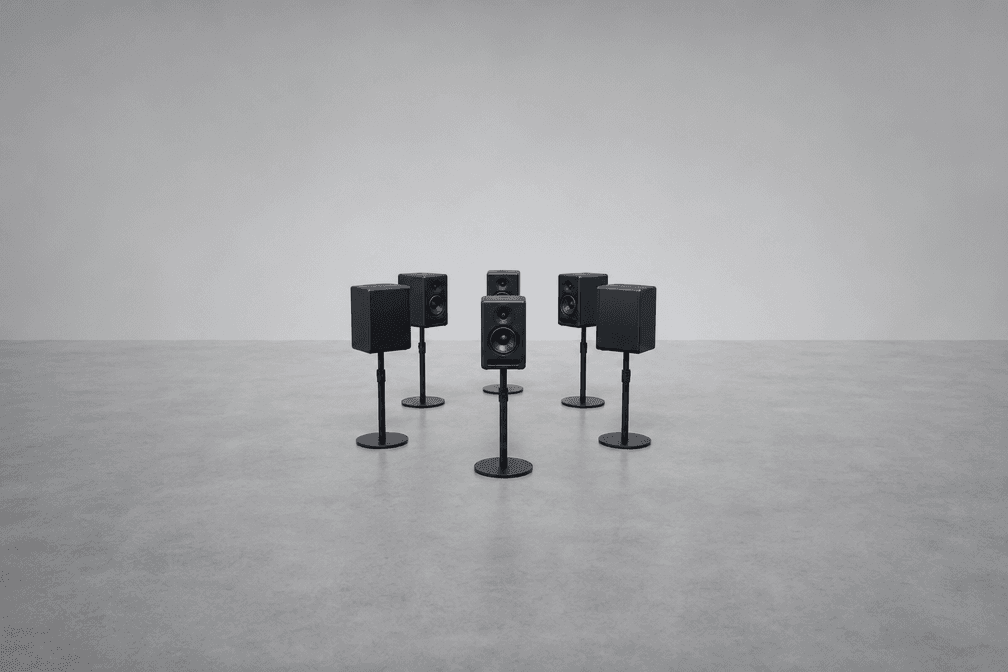
Not yet, for almost everyone reading this. Dolby Atmos treats sounds as objects placed in a three-dimensional space rather than as levels on a left and right channel, and a piece of software called a renderer works out how to play those objects back on whatever the listener actually owns: a room with twelve speakers in it, a soundbar, or a pair of earbuds. Apple Music pays up to 10 percent more per stream on tracks that have a spatial version, which is why the question keeps coming up. What sits between a bedroom producer and that money is a monitoring setup that Sound On Sound costs at £8,200 as a DIY minimum, and an Apple delivery spec that bans the obvious shortcut.
Quick verdict
Already in Logic Pro: the renderer is built in, so you can open an Atmos project tonight for nothing and hear it in binaural. In Ableton Live or FL Studio: neither writes the file Apple wants, so Atmos means changing DAW or handing the stems to someone else. Releasing regularly and after the Apple bonus: paying for an Atmos master is the cheaper route, £250 a track at TYX in London plus your distributor's fee. Building a room: £8,200 to £10,000 before VAT, software or computer, and check Dolby's minimum room size before ordering a single speaker.
What Atmos does that stereo does not
In a stereo mix you decide where a sound sits by how much of it goes to each of two channels. In an Atmos mix you position it in a room, and the renderer decides what each speaker does about that. Dolby's own description for creators is that the Renderer works alongside your DAW to render the mix to any playback environment, using the positional metadata you author in the session. One mix, and the format adapts to twelve speakers or to two earbuds.
The reference layout for music is 7.1.4. That is seven speakers at ear height, four mounted overhead, and one subwoofer. Dolby's setup guide asks for the overhead pairs to sit between 30 and 55 degrees of elevation from the listening position. The LFE channel is a cinema inheritance and Atmos music mixes tend to use it sparingly or leave it alone.
Most people who hear your Atmos mix will hear it on headphones, as a binaural fold-down. Apple's own page says spatial audio is not on by default: listeners pick Automatic, Always On or Off in settings, it works on any Apple or Beats Bluetooth headphones, and wired headphones need Always On selected before it plays at all. That is worth sitting with. A share of the audience never turns it on.
Why Apple Music is the reason anyone asks
In January 2024 Apple started paying more for spatial tracks. Music Business Worldwide reported the mechanism: pro-rata shares for plays where a spatial version exists are calculated with a factor of 1.1, against 1.0 for plays where it does not. The bonus is paid on availability, not on listening, so a track nobody plays in spatial still earns it. Apple framed it as compensation for the extra work an Atmos mix takes.
Then do the arithmetic on your own numbers. Ten percent applies to your Apple Music royalties alone, and only to the tracks with a spatial version. If a release earns £40 a year on Apple Music, the uplift is £4 a year. Against £26.99 to deliver the file through DistroKid, that release needs several years to clear the delivery fee, before anyone is paid for the mix itself.
The other services split the same way. Apple Music, Amazon Music and Tidal all carry Atmos. Spotify carries no spatial format of any kind and has announced no plans to. For a lot of independent artists Spotify is where most of the streams are, so Atmos reaches the smaller half of the audience.
What Apple actually requires
| Requirement | Apple's spec |
|---|---|
| File format | Broadcast Wave Format Audio Definition Model (BWF ADM) |
| Audio | 24-bit LPCM at 48kHz |
| Integrated loudness | No higher than -18 LKFS, measured per ITU-R BS.1770-4 |
| True peak | -1 dB TP maximum |
| Source material | Multitracks or stems only |
That last row is the one that stops most home experiments. Apple's Immersive Audio Source Profile prohibits upmixing from a stereo mix, extracting stems out of a finished stereo release, or dropping a stereo mix into the sound field with effects added around it. You need the session. Anyone selling you a plugin that turns a finished master into Atmos is selling you a delivery Apple's spec rules out.
The loudness number catches people out
-18 LKFS integrated is quieter than a modern stereo master, and Apple measures it per track rather than across an album. Your Atmos version will not match the level of your stereo version, and that is correct rather than a fault. Chasing loudness in an Atmos mix gets the delivery rejected.
Your DAW decides how hard this gets
| DAW | Where it stands on Atmos |
|---|---|
| Logic Pro | Built-in renderer since version 10.7, monitors up to 7.1.4, exports the ADM BWF itself |
| Pro Tools | Native rendering in the 2026.4 release; older versions drive the separate Dolby Atmos Renderer app |
| Cubase Pro and Nuendo | Onboard renderer, mixes and delivers up to 7.1.4 |
| Studio One | Listed by Dolby as supported |
| Ableton Live | No ADM BWF export; multichannel work happens through Max for Live devices and external routing |
| FL Studio | No native Atmos path |
Logic is the reason this is even a bedroom conversation. Apple's manual lists six monitoring formats in Logic's renderer (binaural, 2.0, 5.1, 7.1, 5.1.4 and 7.1.4), and Logic exports the Dolby Atmos master file itself for delivery to a distributor. No extra purchase, no second computer. If you already own Logic, one evening in an Atmos project tells you how much you like the format.
Ableton is the awkward one, and our Logic Pro versus Ableton Live comparison now has a clear answer on this point. Ableton's free Surround Panner device handles four, six and eight-channel setups for installations and theatre work, and it needs Live 12 Standard with Max for Live or Live 12 Suite. It says nothing about Atmos or ADM, because it is built for a different job. Getting an Atmos master out of Live means routing multichannel audio into the Dolby Atmos Renderer on a separate application, which is a workflow rather than a feature. FL Studio has no route at all.
Where you do need Dolby's own software, the Dolby Atmos Renderer has been one application since March 2023, when Dolby folded the old Production Suite and Mastering Suite together. It launched at $299 for new buyers and $50 to upgrade from either old suite. The Dolby Atmos Music Panner, which draws tempo-synced panning moves for objects, is a free download, but it needs one of those suites to run against.
What a room costs
Sound On Sound's guide to setting up an Atmos mixing room carries a costed DIY minimum from engineer Ben Savage. It is the most honest number published anywhere, and it is not a small one.
| Item | Cost |
|---|---|
| 11 speakers | £3,300 |
| Subwoofer | £500 |
| Cabling | £400 |
| Acoustic treatment | £2,000 |
| Interface and monitor controller | £2,000 |
| Total | £8,200 to £10,000, excluding VAT, software and the computer |
Two things in that table deserve attention. The interface line is not the sort of box our audio interface buying guide covers: Sound On Sound puts the minimum at 12 outputs and recommends 16, which is a different class of hardware to a two-in two-out desktop unit. And £3,300 for eleven speakers works out at £300 each, roughly the price of a pair of the monitors in our bedroom studio monitor guide. You are buying five and a half of those pairs.
Then there is the room itself. Dolby's suggested minimum is 3.5m long by 3m wide by 2.4m high. Sound On Sound's practical baseline is larger at about 4.5 by 4.5 by 2.6 metres, at least 50 cubic metres of volume, with a metre and a half between the mix position and every speaker. Most UK bedrooms fail that on ceiling height alone, and the article is blunt about what happens when they do: the lower the ceiling, the closer together the overhead speakers sit, and the smaller the sweet spot gets. Our guide to treating a bedroom studio acoustically is the stereo version of the same problem, and Atmos multiplies it by six.
Mixing on headphones alone is the obvious dodge and Sound On Sound advises against it. Binaural monitoring is worth doing to check what headphone listeners get, since that is most of the audience, but a mix made only through an HRTF is unlikely to translate to speakers. Use headphones to check the fold-down, not to make the decisions.
The routes that skip the room
Paying someone with the room is the sane option, and London prices are public. TYX Studios lists Atmos stem mastering at £250 a track with album discounts, in a 7.2.4 Neumann room, alongside £50 an hour for the studio, £250 for a five-hour half day and £500 for a ten-hour lockout. Metropolis lists mixing from £250 a track. Those are mastering and mixing rates rather than a full Atmos remix from multitrack, which costs more, so get the scope in writing before booking.
Then the file has to reach the stores. DistroKid charges $26.99 a track for the Atmos add-on and delivers to Apple Music, Tidal and Amazon, and the add-on has to be applied at upload rather than bolted onto a release that is already live. TuneCore offers it self-service on new releases; LANDR takes the file through support after the stereo version is out. Velveteen's distributor guide, updated 10 July 2026, makes the point worth repeating: supported does not mean available in your account, so confirm your own plan and country before commissioning anything.
Order of operations
Atmos is not something to add to a finished record. Apple bans upmixed sources, most distributors want the Atmos file at the same upload as the stereo release, and an Atmos mix needs the session with the stems intact. Decide before you master the stereo version, or accept a re-upload as a new release later.
Where to learn it in the UK
This is the one place where a course genuinely buys you something a laptop cannot, because the rooms cost five figures and schools already own them. Several UK institutions in this directory teach in a real Atmos suite.
- Solent University in Southampton is a Dolby Institute Academic Partner, with a 12-speaker Atmos music studio and a 96-seat Atmos cinema.
- Spirit Studios in Manchester lists Marco Migliari as a Dolby Atmos specialist tutor.
- Coventry University runs a dedicated 9.1.4 Atmos studio module inside its Music and Sound Production MA.
- dBs Institute Bristol has an Atmos suite alongside its API 1608 room, and dBs Plymouth has one too.
- BIMM London has a 7.1.4 Atmos room, and NTU London in Whitechapel has two Atmos studios.
- The University of South Wales teaches its BA Music Producing across an Atmos suite at the ATRiuM in Cardiff.
The advice is the same as for any facility claim: book the open day and ask to sit in the room. An Atmos suite on a web page can mean a working 9.1.4 studio with timetabled access, or a demonstration space you see twice in three years. Ask how many hours a student on your course actually gets in it.
Who should bother now
- You release often enough that 10 percent of your Apple Music royalties is a number you would notice.
- You already work in Logic Pro and have a room with the ceiling height and the floor space to take four overhead speakers.
- You want the mixing work rather than the release, and you are building a service other artists pay for.
- Somebody else owns the room: a label, a studio you assist at, or a course with a timetabled Atmos suite.
If none of those fit, the honest move is to make one Atmos mix in Logic, listen to it in binaural, and file the skill away for when the reason arrives. The money does more elsewhere in the meantime. £250 is a mastering budget, a set of monitor stands and treatment for the room you already mix in, or two months of studio time somewhere with better acoustics than your bedroom.
Do I need Dolby Atmos to release music in 2026?
No. Every store still takes a stereo master, and Spotify has no spatial format at all. Atmos is an extra version that earns a royalty uplift on Apple Music and reaches listeners on Apple Music, Amazon Music and Tidal. Releasing without it costs you nothing beyond that uplift.
Can I mix in Dolby Atmos on headphones?
You can work that way, and Sound On Sound advises against relying on it. Binaural monitoring is genuinely useful for checking what headphone listeners hear, since that is how most Atmos music gets played, but a mix made entirely through head-related transfer function processing is unlikely to translate to a speaker layout. Treat headphones as the check rather than the decision-maker.
Is the Dolby Atmos Renderer free?
No. Dolby combined the old Production Suite and Mastering Suite into a single Renderer application in March 2023, launching at $299 for new buyers and $50 as an upgrade for owners of either previous suite. The separate Dolby Atmos Music Panner plug-in is a free download, but it needs one of those suites to work against. Logic Pro and Cubase Pro users need none of it, because their renderers are built in.
Does Ableton Live support Dolby Atmos?
Not natively. Live has no ADM BWF export, so there is no way to produce the master file Apple asks for from inside it. Ableton's free Surround Panner device covers four, six and eight-channel layouts for installations and theatre, and needs Live 12 Standard with Max for Live or Live 12 Suite. An Atmos release from a Live session means routing multichannel audio out to the Dolby Atmos Renderer, or handing the stems to an engineer.
How much more does Apple Music pay for spatial audio?
Up to 10 percent. Since January 2024 Apple has calculated pro-rata shares using a factor of 1.1 for plays where a spatial version of the track exists, against 1.0 where it does not. The bonus depends on the spatial version being available rather than on anyone choosing to listen to it, so it applies to a track nobody plays in Atmos.
Can I convert my finished stereo master into an Atmos mix?
Apple's delivery spec says no. It prohibits upmixing a stereo mix, extracting stems from a stereo release, and placing a stereo mix into the sound field with effects around it. Atmos deliveries have to come from multitracks or stems, which means the decision has to be made while the session still exists.
What is the cheapest way to get one track into Atmos?
Mix it yourself in Logic Pro, which has the renderer and the ADM export built in, then pay the distributor fee. DistroKid charges $26.99 a track and needs the file at the original upload rather than afterwards. If you would rather someone with a proper room did it, TYX in London lists Atmos stem mastering at £250 a track. Building the room yourself starts at £8,200 before VAT.
Sources
Every price and fact above traces to a school or platform's own site, dated on its own listing page. See the methodology for how that works.
- Apple: Immersive Audio Source Profile (Video and Audio Asset Guide)
- Apple Support: About Spatial Audio with Dolby Atmos in Apple Music
- Music Business Worldwide: Apple Music to pay artists up to 10% higher royalties for Spatial Audio
- Billboard: Apple Music to pay higher royalties for Spatial Audio streams
- Dolby Professional: Dolby Atmos for content creators
- Dolby: 7.1.4 overhead speaker setup guide
- Sound On Sound: Setting up an Atmos mixing room
- Sound On Sound: Dolby Atmos Renderer application released
- Sound On Sound: Atmos-capable DAWs
- Apple Support: Spatial Audio with Dolby Atmos monitoring formats in Logic Pro
- Apple Support: Rendering a Spatial Audio with Dolby Atmos mix in Logic Pro
- Ableton: Surround Panner Pack
- Dolby Professional: Dolby Atmos Music Panner plug-in
- TYX Studios London: Dolby Atmos services and rates
- Velveteen: distributors that deliver Dolby Atmos (10 July 2026)
- DistroKid Help Center: uploading a Dolby Atmos mix of your music
- Spirit Studios: tutors