
Home / Blog / The best MIDI keyboards for beginners in 2026
The best MIDI keyboards for beginners in 2026
Four controllers from £72 to £96, what the mini-key versus full-size choice really costs you, and why the software bundles matter more than the price gaps.
Some links below are affiliate links. We may earn a commission if you sign up or buy through one, at no extra cost to you. See our privacy policy.
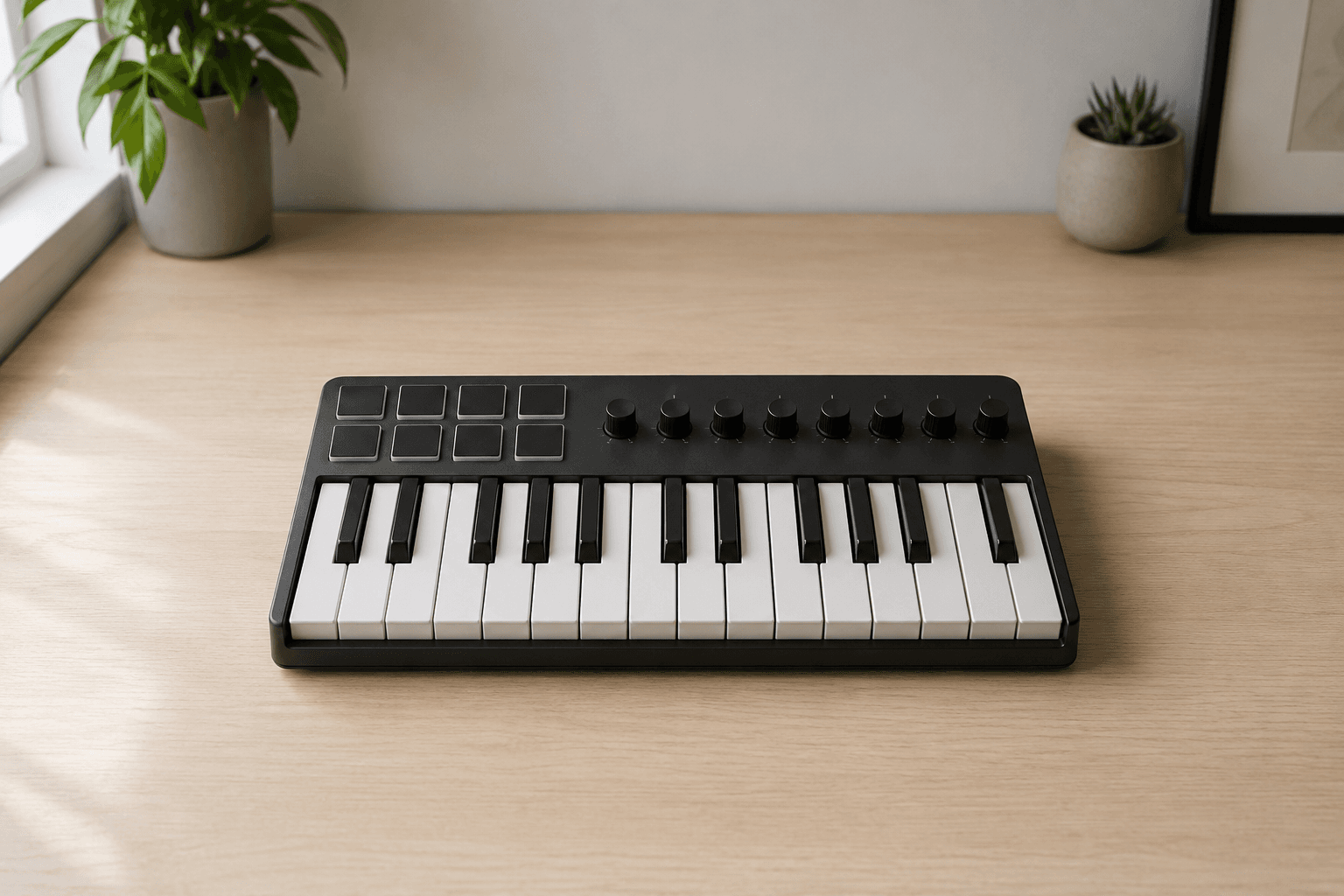
Buy a 25-key mini controller and spend under £100. The Arturia MiniLab 3 at £77 is the one to get if you have no particular reason to pick another. Two things would change that answer: if you already play piano, 25 mini keys will annoy you inside a week, and if you work in Ableton Live, Novation's Launchkey Mini earns the extra £19 it costs.
A MIDI keyboard makes no sound of its own. It sends note, velocity and controller data down a USB cable to a software instrument running in your DAW, and the DAW produces the audio. That's why the sound quality of a controller is a meaningless question, and why the things worth comparing are the feel of the keybed, the number of pads and knobs, and what software comes in the box.
Quick verdict
Most beginners: Arturia MiniLab 3, £77, because four sliders and a proper software bundle do more for you than a slightly nicer keybed. Ableton Live users: Novation Launchkey Mini 25 MK4, £96. Finger-drummers: Akai MPK Mini MK4, £85. Anyone who can already play with two hands: M-Audio Keystation 49 MK3, £72, and accept that you get no pads or knobs with it.
Mini keys or full-size keys, the choice that actually decides this
Every other spec is secondary to this one. Mini keys are roughly three-quarters the width of a piano key. They sit under a laptop screen, fit in a rucksack, and are fine for punching in a bassline, a chord stab or a lead one hand at a time. They are bad for anything you'd recognise as piano playing, because your fingers land between notes when you use a hand shape learned on a normal keyboard.
So the question is what you're going to do with it. Program parts one hand at a time and edit them in the piano roll afterwards, which is how most electronic music gets written: mini keys are fine and the extra desk space is worth having. Play chords and melodies together with two hands: get 49 full-size keys and give up the pads, because nothing at this price gives you both.
The four worth shortlisting
| Arturia MiniLab 3 | Akai MPK Mini MK4 | Novation Launchkey Mini 25 MK4 | M-Audio Keystation 49 MK3 | |
|---|---|---|---|---|
| Price | £77 | £85 | £96 | £72 |
| Keys | 25 slim | 25 mini | 25 mini | 49 full-size |
| Pads | 8, two banks | 8, two banks | 16, poly aftertouch | None |
| Knobs and sliders | 8 encoders, 4 sliders | 8 encoders | 8 encoders | 1 fader |
| Pitch and mod | Two touch strips | Physical wheels | Touch strips | Physical wheels |
| MIDI out | 5-pin DIN | 5-pin DIN | 3.5mm minijack | None |
Prices are Thomann UK's listed inc-VAT prices in August 2026 and move about by £10 either way across retailers, so check two or three before you buy. The whole spread between the cheapest and dearest of these four is £24, which is less than the difference in what they come bundled with.
Arturia MiniLab 3, £77
25 slim velocity-sensitive keys, 8 RGB pads across two banks, 8 rotary encoders, 4 sliders, a small display with a clickable browser knob, a 5-pin MIDI output, USB-C and a pedal input. The four sliders are the reason to pick it over the Akai: they map to a mixer, so you can ride four channel levels by hand instead of drawing every fader move in with a mouse. Nothing else near this price has them.
Pitch bend and modulation are handled by two capacitive touch strips rather than physical wheels, which is the trade-off for the small footprint. They work, but you can't feel where you are on them, so a slow controlled bend takes practice.
Arturia's bundle is Analog Lab Intro, Ableton Live Lite, your choice of one Native Instruments Komplete 15 Select bundle, a Melodics subscription trial, and two months of Loopcloud with two sample packs. Sound On Sound's review is worth reading before you get too excited about Analog Lab Intro: it carries around 500 patches against roughly 9,000 in the paid full version, and only four of the macro controls per patch actually move the instrument, with the rest driving EQ. Their overall verdict was that the MiniLab 3 "carves a niche for itself in the sub £100 budget controller space".
Akai MPK Mini MK4, £85
Akai announced the fourth-generation MPK Mini on 14 October 2025. The redesign replaced the MK3's four-way joystick with real pitch and modulation wheels, added a new keybed and a full-size 5-pin MIDI output, and put a colour screen on the front. It has 8 RGB pads across two banks, 8 assignable encoders, an arpeggiator with pattern, freeze and mutate controls, scale and chord modes, and NKS support for direct control of over 2,000 Native Instruments-compatible instruments.
Buy it for the pads. Akai's pads come out of the MPC lineage and they are the best of these four to actually hit: bigger, softer and more consistent under a finger than Arturia's. If you program drums by tapping rather than by drawing notes into a grid, that's £8 well spent. The whole thing weighs 1.05kg and is 348mm wide, so it still fits in front of a laptop.
Thomann lists the box as including Ableton Live Lite 12, a Melodics trial, access to Splice, the Studio Instrument Collection of over 1,000 presets from AIR, Akai Pro and Moog, and a Komplete 15 Select bundle. Bundles change without notice, so confirm what's current on the listing you buy from rather than trusting a review page.
Novation Launchkey Mini 25 MK4, £96
The dearest of the four and the one with the most pads: 16 of them, with polyphonic aftertouch, laid out in two rows of eight to mirror Ableton Live's Session View grid, one row to launch clips and one to stop them. There are 8 encoders, a sustain input, and iPad and iPhone compatibility because it's class-compliant.
One catch worth knowing before you order: its MIDI output is a 3.5mm minijack rather than a full-size 5-pin DIN socket, so plugging it into a hardware synth needs the supplied adapter. The MiniLab 3 and MPK Mini both give you the full-size socket directly.
Novation's argument across the whole Launchkey range is DAW control rather than the keybed. The full-size Launchkey 25 MK4, £169.99 with 25 full-size synth-action keys and a 128x64 OLED display, ships with custom scripts for Ableton Live 11 and later, Logic, Cubase 11 and 12, Reason, FL Studio and Ardour, plus HUI support for everything else. If you're still picking software, our DAW guide covers that decision first; buying a controller around a DAW you haven't settled on is the wrong order.
M-Audio Keystation 49 MK3, £72
The odd one out, and the cheapest. 49 full-size velocity-sensitive keys with unweighted synth action and no aftertouch, pitch and modulation wheels, transport buttons, one fader, a sustain pedal input, and USB bus power. No pads. No encoders. No display. It is 822mm wide and weighs 2.1kg, so it needs a desk it can live on permanently.
Get this one if you have piano lessons behind you and playing two-handed matters more than tapping out drums. Everyone else will miss the pads and knobs within a month. M-Audio bundles it with Ableton Live Lite, MPC Beats, the AIR Mini Grand, Velvet and Xpand!2 instruments, and a 2GB Touch Loops sample library.
What none of them do at this price
- Weighted or hammer-action keys. All four have unweighted spring-loaded keys that feel nothing like a piano. If you want to practise piano and produce on the same instrument, a digital piano with a USB MIDI socket does both and starts around £400.
- Aftertouch on the keybed. Only the pads respond to pressure, and only the Launchkey Mini's do it polyphonically.
- Anything that improves your recordings. A controller sends data, so it has no effect on audio quality. If you also need to record vocals or guitar, that's an audio interface, and our interface guide covers what to spend there.
The software in the box changes the maths
All four include Ableton Live Lite, a real licence for the cut-down Lite edition of Live rather than a time-limited trial, and the Arturia and the Akai both add a Native Instruments Komplete 15 Select bundle on top. None of that software is sold at anything like the price of the hardware it comes attached to. That's the honest reason the £24 spread between these four barely matters: you are mostly choosing a control layout, and the maker throws in software to win the sale.
It also means the bundle is a bad reason to spend more than you planned. Free DAWs and instruments already cover the same ground, as our free DAW roundup and free plugin guide go through, and a Komplete Select bundle you never open is worth nothing.
Which one to buy
- No strong preference, general electronic production: Arturia MiniLab 3, £77. The four sliders and the 5-pin MIDI output are the practical advantages.
- You make beats and want to play drums with your fingers: Akai MPK Mini MK4, £85, for the MPC pads and the new pitch and mod wheels.
- You've committed to Ableton Live and want Session View under your hands: Novation Launchkey Mini 25 MK4, £96.
- You can already play piano: M-Audio Keystation 49 MK3, £72, and buy pads separately later if you find you want them.
- You're not sure you'll stick with production: buy nothing yet. You can write everything with a mouse and the piano roll, and as our piece on gear argues, an unopened box teaches you nothing.
Do I actually need a MIDI keyboard to produce music?
No. Every part in a track can be drawn into the piano roll with a mouse, and plenty of released records were made that way. A controller makes writing melodies and chords faster and more musical, which is a real benefit, but it isn't a requirement for finishing a track.
Are 25 keys enough?
For one-handed parts, yes. 25 keys covers two octaves, and an octave shift button reaches the rest of the range. It runs out when you want to play a bassline and a chord voicing at the same time, which is where 49 keys starts to matter.
Are mini keys bad if I've had piano lessons?
You'll find them cramped. Mini keys are about three-quarters the width of a normal piano key, so hand shapes learned on a full-size keyboard land between notes. If you play two-handed, the 49-key M-Audio Keystation at £72 is the better buy even though it has no pads or knobs.
Do I need an audio interface as well as a MIDI keyboard?
Not for the keyboard itself, which connects over USB and needs nothing else. An interface is for getting microphones and instruments into the computer and for lower-latency monitoring; our audio interface guide covers when it's worth buying one.
Will these work with my DAW?
All four are class-compliant, so any DAW will see them as a MIDI input with no driver installation. What varies is the deeper integration: Novation writes custom scripts for Ableton Live, Logic, Cubase, Reason, FL Studio and Ardour, and Akai supports Native Instruments NKS for controlling Komplete instruments directly.
Is it worth paying more for weighted keys?
Only if you play piano properly. Weighted and hammer-action keybeds start well above £100 and none of the controllers here have them. If piano practice and production are both on the list, a digital piano with USB MIDI out is better value than buying a controller now and a piano later.
Should I buy second-hand instead?
It's reasonable for these, since there's little to wear out beyond the keybed and the pads. Test every key and pad at several velocities before paying, and check the USB socket isn't loose. Older models like the MPK Mini MK3 sell cheaply, though you lose the MK4's pitch and mod wheels and its full-size MIDI output.
Sources
Every price and fact above traces to a school or platform's own site, dated on its own listing page. See the methodology for how that works.
- Arturia: MiniLab 3 overview
- Thomann UK: Arturia MiniLab 3 Black
- Thomann UK: AKAI Professional MPK Mini IV Black
- Thomann UK: Novation Launchkey Mini 25 MK4
- Thomann UK: M-Audio Keystation 49 MK3
- Novation: Launchkey 25 MK4
- MusicRadar: Akai unveils MPK Mini IV with pitch and mod wheels
- inMusic press release: MPK Mini IV
- Sound On Sound: Arturia MiniLab 3 review