
Home / Blog / Best hardware synths for beginners under £500
Best hardware synths for beginners under £500
Six synths from £113 to £495, which ones you can play without a separate keyboard, and the honest case for learning synthesis on free Vital before you buy any of them.
Some links below are affiliate links. We may earn a commission if you sign up or buy through one, at no extra cost to you. See our privacy policy.
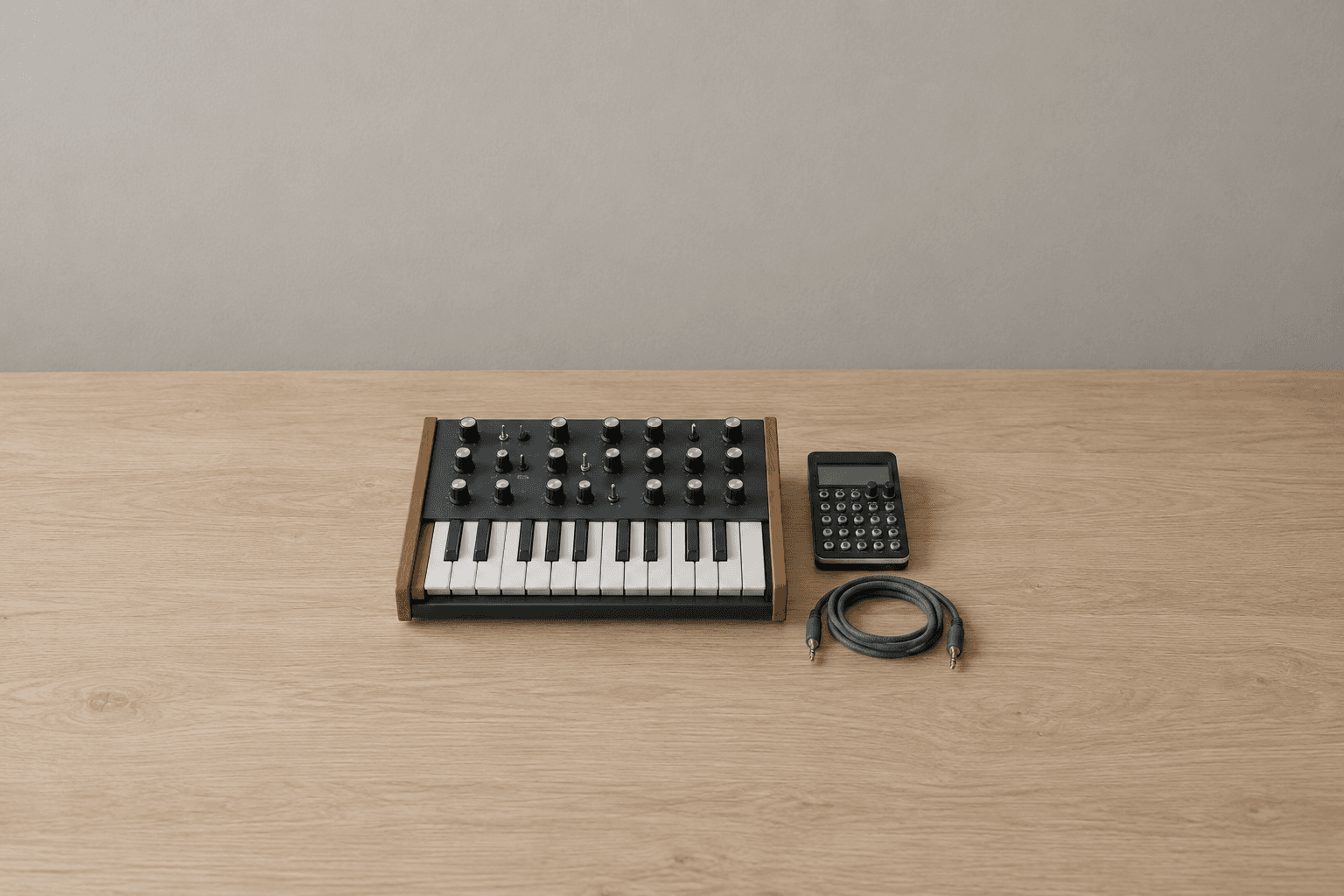
If you want one hardware synth to learn on, buy the Novation Bass Station II at £379. It has 25 full-size keys, two analogue oscillators and a front panel laid out in the order the sound actually travels, so turning the knobs left to right teaches you subtractive synthesis. If £379 is too much, the Behringer Crave at £113 teaches the same lessons, but it has no keyboard, so budget for a controller as well.
Before you spend anything, though, be honest about why you want hardware. Vital is free, runs in any DAW, and covers far more synthesis ground than anything on this list, as our Serum vs Vital comparison goes through. What a hardware synth gives you is one knob per job and no menus, which makes it quicker to learn what a filter or an envelope does by ear. It does not give you a better sound than software at this price.
Quick verdict
Best for learning synthesis: Novation Bass Station II, £379. Cheapest route into analogue: Behringer Crave, £113, plus a MIDI keyboard. Most sounds for the money: Arturia MicroFreak, £245. Chords and pads: Korg minilogue xd, £495, the only one here with more than four voices of analogue polyphony. Small, battery-powered and fun: Roland S-1, £159, or Korg volca keys, £118.
Does a hardware synth teach you more than Vital
Sometimes. The argument for hardware is about attention rather than sound. In Vital you can reach every parameter, but you reach it with a mouse, one control at a time, and it is easy to load presets and never touch anything. On a Bass Station II the filter cutoff is a large knob in the middle of the panel and you hear the result the moment you turn it. Two hands on two knobs at once is something a mouse cannot do.
The argument against is just as plain. A mono synth plays one note at a time, so you cannot play a proper chord on half the synths below. Recording hardware into a DAW needs an audio interface with a spare input, and every patch you make has to be recorded as audio or saved on the synth itself. Vital saves with the project and recalls instantly. If you have never finished a track, our piece on gear makes the case for holding off.
The six worth shortlisting
| Price | Keys | Voices | Sound engine | Battery | |
|---|---|---|---|---|---|
| Behringer Crave | £113 | None | 1 | Analogue, semi-modular | No |
| Korg volca keys | £118 | 27-note touch strip | 3 | Analogue | Yes, 6 x AA |
| Roland S-1 | £159 | Button keyboard | 4 | Virtual analogue | Yes, built in |
| Arturia MicroFreak | £245 | 25 flat touch keys | 1 (4 paraphonic) | Digital oscillator, analogue filter | No |
| Novation Bass Station II | £379 | 25 full-size | 1 | Analogue | No |
| Korg minilogue xd | £495 | 37 slim | 4 | Analogue plus digital | No |
Prices are Thomann UK's listed inc-VAT prices on 1 October 2026. The Crave showed a three to four week wait for stock that day; the others were in stock. Synth prices move around more than most gear, so check two retailers before you buy.
Behringer Crave, £113
A desktop analogue mono synth with one oscillator based on the CEM3340 chip, sawtooth and pulse waves, a noise generator, and a 24dB ladder filter that switches between low-pass and high-pass. There is one ADSR envelope, one LFO, a 32-step sequencer with 64 memory slots, and an arpeggiator. The patch panel has 18 inputs and 14 outputs, and six patch cables come in the box.
It is the cheapest way to own a real analogue signal path, and the patch bay lets you reroute it once the basic layout makes sense. The catch is that it has no keyboard. You program it from the sequencer buttons or play it from a MIDI controller over USB or 5-pin MIDI. Our MIDI keyboard guide has the Arturia MiniLab 3 at £77, which brings the Crave to about £190 all in, still half the price of a Bass Station II.
Korg volca keys, £118
A palm-sized analogue synth with three oscillators, one filter, one envelope and one LFO, a delay, a loop sequencer with motion recording, and a built-in speaker. It runs on six AA batteries or an optional mains adapter, which is sold separately. The three oscillators can play as a three-note chord, so you get simple polyphony at this price.
The keyboard is a 27-note touch strip with no velocity, which is fine for programming the sequencer and awkward to play. There is a MIDI input but no MIDI output and no USB, so recording it means running the headphone output into an interface. Treat it as a sketchpad you pick up on the sofa rather than a studio centrepiece.
Roland S-1, £159
Roland's pocket synth runs the same circuit-modelling engine as its larger AIRA gear, built around the SH-101. It has four voices, an oscillator with square, sawtooth, sub-oscillator and noise, a Draw mode for making your own waveforms, a resonant low-pass filter, an LFO with six shapes, and delay, reverb and chorus. The sequencer runs to 64 steps with motion recording and probability.
Two things make it easy to live with. The built-in battery lasts up to four and a half hours and charges over USB-C, and the same USB-C cable carries audio and MIDI into your computer, so you can record it without an audio interface. The keys are small buttons with no velocity, so like the volca it suits sequencing more than playing. It is the only synth here you could take on a train and record straight into a laptop.
Arturia MicroFreak, £245
The odd one out. The MicroFreak's oscillator is digital, with 21 modes on Arturia's current page, including wavetable, FM, granular, Karplus-Strong string modelling, sample playback and a vocoder, several of them licensed from Mutable Instruments and Noise Engineering. That digital oscillator feeds an analogue filter. It ships with 320 factory presets across 512 slots, and has a 64-step sequencer and a modulation matrix.
The keyboard is a flat printed circuit board with 25 touch-sensitive keys and polyphonic aftertouch. Nothing moves under your finger, which takes getting used to if you have played a normal keyboard, but the pressure sensing is more expressive than anything else here. For a beginner it is a lot of sound for the money, though the range of oscillator modes makes it a less direct teacher of subtractive basics than the Bass Station II.
Novation Bass Station II, £379
Two analogue oscillators plus a sub-oscillator, two filter types (Classic and Acid), two envelopes, two LFOs, an analogue distortion, a step sequencer and an arpeggiator, with 64 factory and 64 user patches. It is monophonic. The 25 keys are full-size and velocity-sensitive with assignable aftertouch, so it doubles as a MIDI controller for your DAW over USB.
The reason it tops this list is the panel. Oscillators sit on the left, the mixer next to them, then the filter, then the envelopes, so the layout follows the signal. Thomann reviewers repeatedly mention how easy it is to follow, and that matches the way synthesis is usually taught. Every patch you build on it transfers directly to Vital, Serum or any other subtractive synth later.
Korg minilogue xd, £495
The only polyphonic analogue synth here. Each of its four voices has two analogue oscillators plus a digital multi-engine with noise, VPM (Korg's FM-style engine) and user slots for downloadable oscillators. It has 37 slim velocity-sensitive keys, a joystick for pitch and modulation, a 16-step polyphonic sequencer with motion recording, and modulation, delay and reverb effects. It stores 500 programs, 200 of them presets.
Buy it if you want to play chords and pads on hardware, which nothing else on this list does properly. It sits right at the £500 limit, and with the slim keys and four voices it is still a compact synth rather than a full keyboard workstation.
What none of these do
- Save with your DAW project. Hardware patches live on the synth, so you need to record the part as audio or note the settings, or you lose the sound when you change the patch.
- Record without an interface, except the Roland S-1 over USB. The rest need a line input on an audio interface, which our interface guide covers.
- Replace software. Even the minilogue xd has four voices. A pad with eight notes held down, or a stack of three synth layers, is a software job.
Which one to buy
- You want to understand synthesis properly and play it from its own keys: Novation Bass Station II, £379.
- You want analogue on the smallest budget and already own a MIDI keyboard: Behringer Crave, £113.
- You want the widest range of sounds from one box: Arturia MicroFreak, £245.
- You want chords and pads on hardware: Korg minilogue xd, £495.
- You want something portable to sequence away from the desk: Roland S-1, £159, or the cheaper volca keys at £118 if you can live without USB.
- You have not finished a track yet: download Vital and spend nothing. Our free plugin guide lists what else is worth installing alongside it.
Is a hardware synth worth it for a beginner?
Only if you want to learn synthesis hands-on and already make music regularly. Free software synths such as Vital cover more ground than any hardware under £500. What hardware adds is a dedicated control for each parameter, which can make the concepts quicker to pick up.
What does monophonic mean, and does it matter?
A monophonic synth plays one note at a time. That is fine for basslines and leads, which is what most mono synths get used for, but you cannot play a chord on one. The Crave and Bass Station II are mono, the MicroFreak manages four notes only in a limited paraphonic mode, and the volca keys, S-1 and minilogue xd can play three or four notes together.
Do I need an audio interface for a hardware synth?
For most of them, yes, with a spare line input to record into your DAW. The Roland S-1 is the exception on this list because it sends audio over USB-C. You can also listen through headphones on all of them without a computer at all.
Do I need a separate MIDI keyboard?
Only for the Behringer Crave, which has no keyboard. The others all have something to play, though the volca keys' touch strip and the S-1's buttons have no velocity and suit sequencing more than playing.
Is analogue better than digital?
Not in a way a beginner will hear in a mix. Analogue synths drift slightly and respond to knob moves in a way some people prefer, but a well-made software synth recorded through a decent interface sounds just as good on a finished track. Pick by layout and features, not by circuit type.
Should I buy a used synth?
It is a sensible option for all six of these, since they are long-running models with plenty of second-hand stock. Check every knob for crackle, every key or pad for response, and that the power supply is included with a Crave, since it cannot run without one.
Can I learn synthesis without buying any hardware?
Yes. Vital is free and has a clear layout of oscillators, filters, envelopes and LFOs, and most synthesis courses teach on software. Buying hardware later is easier once you know which controls you keep reaching for.
Sources
Every price and fact above traces to a school or platform's own site, dated on its own listing page. See the methodology for how that works.
- Thomann UK: Behringer Crave
- Thomann UK: Korg Volca Keys
- Thomann UK: Roland AIRA Compact S-1 Tweak Synth
- Thomann UK: Arturia MicroFreak
- Thomann UK: Novation Bass Station II
- Thomann UK: Korg Minilogue XD
- Arturia: MicroFreak overview
- Korg UK: minilogue xd
- Novation: Bass Station II
- Roland UK: S-1 Tweak Synth
- Korg UK: volca keys