
Home / Blog / Vinyl vs digital DJing: which should you learn first
Vinyl vs digital DJing: which should you learn first
Digital first for almost everyone. What two decks and a mixer cost against a £299 controller, which skills transfer, and where DVS fits in.
Some links below are affiliate links. We may earn a commission if you sign up or buy through one, at no extra cost to you. See our privacy policy.
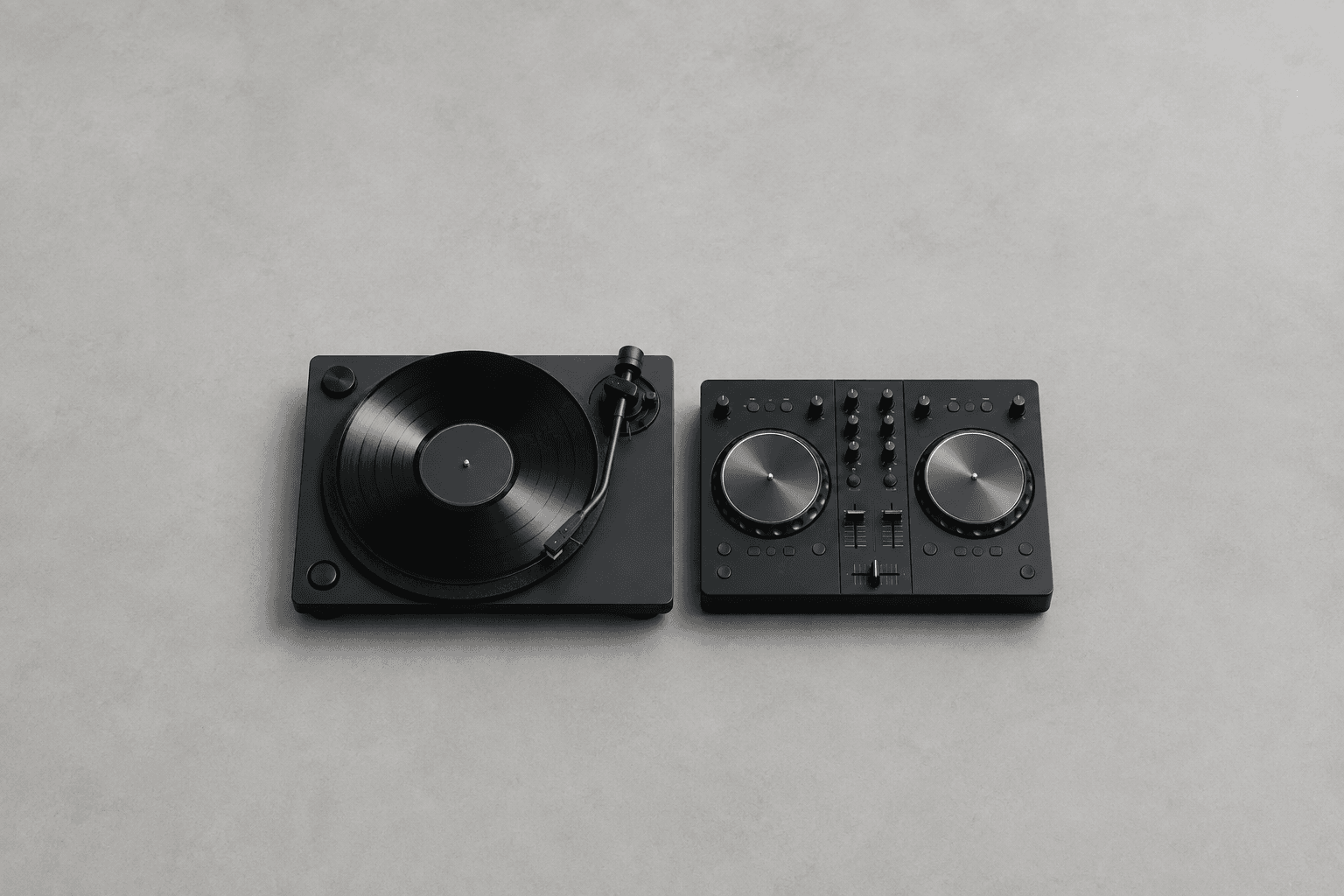
Learn digital first, unless the records you want to play only exist on vinyl. Two turntables and a mixer you can genuinely learn on start at £727 at Westend DJ. A Pioneer DJ DDJ-FLX4 controller is £299 and a Hercules DJControl Inpulse 200 MK3 is £89.99, and the beatmatching you learn on any of them is the same physical skill. Vinyl is the better first purchase for one type of person: the one who already owns records, or who wants to play music that was never released as a file.
Hardware prices below were taken from Westend DJ on 2 September 2026, and the controller prices from our own check the day before. Software prices come from Serato and rekordbox directly. Serato bills in US dollars, so your card issuer's exchange rate applies on top.
Quick verdict
Starting from nothing, no records at home: a controller. £89.99 buys the Hercules Inpulse 200 MK3, £299 buys the Pioneer DDJ-FLX4 layout you will meet in a club booth. Already collecting records, or playing music that was never digitised: two Reloop RP-4000 MK2 decks and a Reloop RMX-10 BT mixer, £727 all in. Scratching and battle DJing: turntables, and there is no digital shortcut worth taking. Planning to play out in clubs: learn on either, then learn CDJs, because that is what is installed.
What each setup costs
A DJ turntable is a different machine from a record player. It needs direct drive, so the platter reaches speed instantly and holds it under your hand, a pitch fader so you can change that speed, and enough torque that pushing the record does not stall the motor. Reloop's RP-4000 MK2 has a brushless motor rated above 1.8 kg/cm, three speeds at 33, 45 and 78 rpm, a pitch range switchable between 8 and 16 per cent either way, and an Ortofon OM Black cartridge already fitted to the headshell. That last detail is worth money: cartridges are usually sold separately and a decent pair can add most of £200.
The mixer is where corners get cut. It needs phono inputs, because a turntable's output is far quieter than a line signal and has to be corrected before it reaches an amplifier, and it needs a cue mix control so you can hear the incoming record against the one already playing. Reloop's RMX-10 BT has both, plus a three-band EQ on each channel and a replaceable crossfader, at £129.
| Setup | UK price | What you get | What it plays |
|---|---|---|---|
| Hercules DJControl Inpulse 200 MK3 | £89.99 | Two decks, four pads, beatmatch light guides | Files |
| Pioneer DJ DDJ-FLX4 | £299 | Club-style layout, mic input, eight pads a deck | Files |
| Two Reloop RP-4000 MK2 plus Reloop RMX-10 BT | £727 | Direct drive, Ortofon cartridges fitted, 3-band EQ | Records |
| Two Pioneer PLX-500 plus Allen & Heath Xone:24C | £1,117 | Heavier decks, analogue filter, better build | Records |
| Two Reloop RP-4000 MK2 plus Pioneer DJ DJM-450 | £1,277 | The same decks with DVS built into the mixer | Records or files |
| Two Technics SL-1210 MK7 | £1,598 before a mixer | The deck most club booths are built around | Records, or files with DVS |
Westend DJ lists the SL-1210 MK7 at £799 on pre-order rather than in stock, which is worth knowing before you plan a setup around a pair. Nothing here needs you to start at that level. The Reloop at £299 does the same job for a beginner, and the Pioneer PLX-500 at £339 sits between the two.
The skills mostly transfer
Beatmatching by ear works the same way on both. You cue the incoming track in your headphones, start it on the beat, then hold it there with the pitch control while your other hand nudges the platter or the jog wheel. On a controller that nudge goes through a jog wheel with no record under it; on a turntable it is your fingers on vinyl. Corrections are smaller and slower to settle on a turntable, and the feedback is more honest, but it is one skill and DJs move between the two without retraining.
EQ blending, gain staging and phrasing are identical, and phrasing is what beginners get wrong on either format. Where the two split is in what the format hides. A controller draws you a waveform, so you can see a drop coming before you hear it, and a sync button will lock two tracks together whether or not you understand why. Vinyl shows you nothing. That is the honest argument for learning on records, and a controller with the waveform ignored and sync switched off gets you most of the same benefit for a fraction of the money.
Two things only vinyl teaches: needle dropping, which is finding a point in a track by eye and putting the stylus on it, and handling a record that is already playing without stopping it. Two things only digital gives you: hot cues and loops you can set anywhere in a track, and a library that fits on a laptop instead of in the boot of a car.
DVS: turntables that play files
A digital vinyl system sidesteps the argument. You put a control record on the turntable, carrying a timecode signal instead of music, and the software reads your movements and triggers the file you have selected on screen. The platter, the needle and the pitch fader all stay. The crate goes. Most UK DJs who play records at gigs and files at home are running some version of this.
It costs more than either pure setup, because it needs a mixer or an interface that supports it. Pioneer's DJM-450 is £679 at Westend DJ with DVS built in. Software sits on top of that: rekordbox lists DVS control on all four of its plans including Free, with the paid tiers at £12 a month for Core, £18 for Creative and £36 for Professional. Serato charges separately. DJ Pro is $299 outright or $11.99 a month, and the DVS expansion comes inside DJ Suite at $499 outright or $14.99 a month.
AlphaTheta's PLX-CRSS12, £1,179 at Westend DJ, goes further than that. Its Magvel Clamp holds an ordinary record magnetically and reads your hand rather than the groove, so it controls Serato DJ Pro or rekordbox with no timecode record and no tonearm in use, which means no skipping however hard you scratch. It still needs a DVS-capable mixer to sit behind it. Digital DJ Tips reviewed it as a real hybrid instrument rather than a novelty. It is a poor first turntable at that price, and it is the clearest sign of where this argument has settled.
Records cost money, files cost less
Vinyl is not a dying format and it is not a cheap one. BPI figures for 2025 put UK vinyl at 7.6 million units and £174.7 million of trade revenue, an eighteenth consecutive year of growth and 62.9 per cent of all physical music revenue. Divide one figure by the other and you get roughly £23 a record at trade value, before a shop adds its own margin.
Two hours of mixing full tracks is somewhere around 25 to 30 records. Buying that from nothing costs several hundred pounds on top of the decks, and it repeats every time you want new music. A digital DJ buys the same tracks for a few pounds each and carries all of them. Some people play better sets under the constraint of a record bag. Most do not, and either way it is a running cost rather than a one-off.
What UK DJ schools teach
The tuition market has already answered this. Most DJ teaching in the UK is sold on Pioneer controllers and CDJs, and vinyl is a separate, dearer course where it is offered at all. London DJ Academy prices an eight-hour Vinyl DJ and Digital DVS course at £399 against £349 for its standard eight-hour beginner course. London Sound Academy sells its Vinyl DJ course at £649 for six lessons, where the standard four-lesson DJ course is £369.
For scratching the ratio flips and vinyl wins outright. Up2Scratch DJ Academy in Brighton is run by a turntablist of twenty years and sells six-lesson beginner mixing, scratch or beat juggle packages at £300, or single two-hour lessons at £60. Creative DJ School in Sheffield teaches on CDJs, vinyl decks and controllers side by side and starts with a one-hour taster at £35. If you are weighing tuition against teaching yourself, our piece on online versus in-person courses covers where that money goes.
Which to learn first
- No records at home and you want to play out: digital. Buy the Pioneer DDJ-FLX4 at £299, turn sync off, and spend the £400 you saved on music and a lesson.
- Testing whether you like DJing at all: digital, at £89.99 for the Hercules Inpulse 200 MK3. Vinyl is an expensive way to find out, and £727 of decks is harder to sell on than a controller if the answer turns out to be no.
- Scratching, beat juggling and hip hop: vinyl, and skip the rest of the debate. Two Reloop RP-4000 MK2 decks and an RMX-10 BT at £727 teach you everything a £1,859 Pioneer DJM-S11 would.
- You already own records, or you play music that was never released digitally: vinyl. The collection is the reason, and it is the one reason that beats the price gap.
- Playing in clubs inside a year: digital first, then get in front of CDJs, because that is what the booth has whatever you learned on. Our guide to gear covers why the expensive version of this decision rarely changes the outcome.
Is beatmatching actually harder on vinyl?
Slightly, and only at the start. A turntable's pitch fader changes the record's real speed, so your corrections are physical and take a moment longer to settle than a jog wheel nudge. The skill underneath is the same, which is why DJs move between the two without relearning it.
Can I use the record player I already own?
Almost certainly not. A belt-drive hi-fi turntable has no pitch control, takes a second or two to reach speed, and stalls if you touch the record. You need direct drive and a pitch fader, which starts at £299 for the Reloop RP-4000 MK2 or £339 for the Pioneer PLX-500.
Do I need a phono preamp as well?
Only if your mixer has no phono inputs. A turntable's output is much quieter than a line signal and needs correcting before it hits an amplifier. Every DJ mixer has phono inputs built in, including the £129 Reloop RMX-10 BT, and a hi-fi amp with a socket marked phono works too. Plug a turntable into a line input and you get a thin, quiet signal.
What is DVS, and do I need it?
Digital vinyl system: a control record carrying timecode instead of music, which lets a turntable drive a file in Serato or rekordbox. You need it if you want the feel of vinyl without buying and carrying records. It needs a supporting mixer or interface, so the cheapest sensible route is a DVS-capable mixer such as the £679 Pioneer DJM-450 rather than a separate box.
Does playing vinyl help you get bookings?
No. Promoters book DJs on their music and their audience. A vinyl-only policy exists at a handful of nights and works as a constraint rather than an advantage, and most UK booths have a pair of CDJs and a DJM installed, with turntables something you have to request in advance. Ask before you turn up with a record bag.
How many records do I need before I can play a set?
Around 25 to 30 for two hours if you mix full tracks, and more than that if you want any choice in the moment. Starting from nothing, that is the real cost difference between the two formats, and it recurs. The hardware gap is a one-off; the music gap is not.
Will learning on a controller hold me back on turntables later?
Not if you learn without sync. Going from small jog wheels to a 12-inch platter takes an afternoon of adjustment. The habits that take longer to unlearn are leaning on the sync button and reading waveforms instead of listening, and both of those are choices you can avoid from day one on any controller.
Sources
Every price and fact above traces to a school or platform's own site, dated on its own listing page. See the methodology for how that works.
- Westend DJ: DJ turntables, prices checked 2 September 2026
- Westend DJ: Technics SL-1210 MK7, £799
- Westend DJ: Pioneer DJ PLX-500, £339
- Westend DJ: DJ mixers
- Reloop: RP-4000 MK2 specifications
- Reloop: RMX-10 BT specifications
- Serato: DJ Pro and DJ Suite pricing
- Serato: DJ expansions, including DVS
- rekordbox: plans and pricing
- Pioneer DJ: PLX-CRSS12 product page
- Pioneer DJ news: introducing the PLX-CRSS12
- Digital DJ Tips: Pioneer DJ PLX-CRSS12 review
- BPI: UK recorded music market passes £1.5 billion in 2025